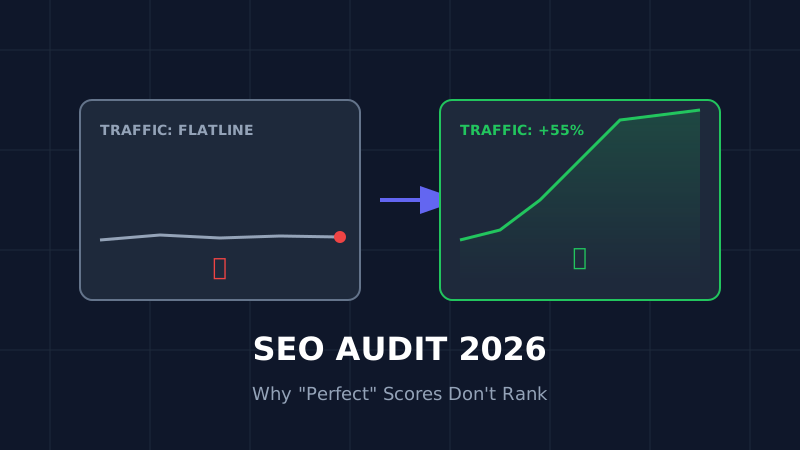
Your site has a 100/100 score on PageSpeed Insights. You post "quality content" three times a week. You have 50 backlinks.
And your traffic is flatlining.
Stop blaming the algorithm. Blame your audit.
Most SEO audits in 2026 are worthless PDF reports generated by automated tools. They tell you to "fix broken links" and "add alt text," while ignoring the silent killers that are actually destroying your rankings.
The game has changed. Google's 2026 Core Updates aren't looking for keywords anymore. They're looking for User Experience Signals and Content Authenticity.
If you're still auditing your site like it's 2023, you're optimizing for a version of Google that no longer exists.
Here is the brutal, no-fluff SEO audit checklist that actually moves the needle in 2026.
The "Green Score" Illusion
Let's start with the biggest lie in SEO: "A perfect technical score means I rank."
Wrong.
I've seen sites with technically perfect code rank on page 5. I've seen ugly, messy sites rank #1.
Why? Because Google ranks results, not code.
If your code is clean but your Largest Contentful Paint (LCP) is 4 seconds because of a massive hero image, you lose. If your content is grammatically perfect but reads like ChatGPT, you lose.
The Three Lies of Modern SEO Audits
Lie #1: "More Content = More Traffic"
In 2026, content velocity is a risk factor. If you publish 50 posts a month and they are all "meh," Google views your entire domain as a low-quality content farm. Pruning (deleting) bad content is often more effective than creating new content.
Lie #2: "Alt Text Is for Keywords"
Stop stuffing keywords into image descriptions. Google's vision AI reads the image better than you do. Alt text is for accessibility. If you try to game it, you get flagged for over-optimization.
Lie #3: "Core Web Vitals Are Just a Tie-Breaker"
This was true in 2021. In 2026? Core Web Vitals are the gatekeeper. If you fail INP (Interaction to Next Paint) or LCP, you don't even get invited to the ranking party for competitive keywords.
The Math of Speed: Milliseconds = Money
We all know "fast is better." But let's look at the financial cost of a slow LCP.
| Metric | 1.8s Load Time (Good) | 3.5s Load Time (Bad) |
|---|---|---|
| Bounce Rate | 22% | 58% |
| Pages Per Session | 4.2 | 1.9 |
| Conversion Rate | 3.8% | 1.1% |
| Avg. Session Value | ₹450 | ₹120 |
| Lost Revenue/Year | ₹0 | ₹12,00,000+ |
*Based on 10k monthly visitors.*
You are bleeding money every time that loading spinner spins.
The 2026 Audit Checklist (The Stuff That Matters)
Forget the 50-page PDF. Check these 5 things. Now.
1. The LCP Image Check (The #1 Traffic Killer)
The Problem: Your "Largest Contentful Paint" (LCP) is usually your Hero Image. If it takes >2.5 seconds to load, Google hates you.
The Audit:
- Open your site in Incognito.
- Right-click -> Inspect -> Network -> Select "Slow 4G".
- Refresh. Watch that big image at the top. Does it load instantly? Or does it "chunk" in?
The Fix:
Most people upload 2MB PNGs straight from Canva. Stop doing this.
- Resize it: A blog header never needs to be wider than 1200px. Use the Image Resizer to scale it down.
- Compress it: Convert it to JPG/WebP and crush the file size. Use the Image Compressor to strip 70% of the weight without losing quality.
- Result: A 2MB image becomes 80KB. LCP drops from 4s to 0.8s. Rankings go up.
2. The "AI Stench" Test (Content Quality)
The Problem: You used AI to write your category pages or blogs, and now they "smell" robotic.
The Audit: Read your top 5 pages out loud. Do you hear words like "realm," "delve," "landscape," or "unleash"? If yes, you have Robot Breath.
The Fix: Run your content through the AI to Human Text Converter. But don't just rely on tools. Add personal experience.
3. The "Orphan Page" Safari
The Problem: You have great posts that are buried 5 clicks deep. Google can't find them. Users can't find them.
The Audit: Go to your sitemap. Pick a random post from 2024. Try to navigate to it from your homepage without using the search bar. If it takes more than 3 clicks, it's an orphan.
The Fix: Add "Related Posts" sections manually. Link old high-value posts from your new content. Revive the dead.
4. The JavaScript Bloat Check (INP)
The Problem: Your site loads, but when a user clicks a button, nothing happens for 0.5 seconds. That's Interaction to Next Paint (INP).
The Audit: Click around your mobile menu wildly. Does it stutter?
The Fix: Defer third-party scripts. Do you really need the drift chat bot, the heatmap tracker, AND the push notification bell loading on every single page? Kill the bloat.
Case Study: The "Image Heavy" Disaster
Client: Lifestyle Blog
Traffic: Dropped 40% in March 2025.
The Audit: We found that every blog post had 10+ unoptimized images. Each page was 8MB+. LCP was 5.2 seconds on mobile.
The Fix:
- We ran all 4,000 images through the Image Compressor.
- Set up lazy loading.
- Resized huge backgrounds using the Image Resizer.
The Result (30 Days Later):
- Page Size: 8MB -> 1.1MB
- LCP: 5.2s -> 1.4s
- Traffic recovery: +55% (surpassed previous highs).
The "Laziness Tax" Is Real
Ignoring technical SEO in 2026 is expensive.
You can write the best content in the world, but if your doorway is blocked by a slow-loading image or a broken script, nobody is coming in.
Your Action Plan for Today:
- Run a PageSpeed test on your top 3 pages.
- If LCP is >2.5s, optimize your images immediately. Use the Image Resizer first, then the Image Compressor.
- Read your homepage copy. If it sounds like a robot, rewrite it.
SEO isn't magic. It's discipline. Do the boring work, and you'll get the exciting results.

Deep Mistry
Digital Marketing Expert | AI & Business Growth Specialist
Deep Mistry is a Digital Marketing Expert specializing in AI-driven growth strategies and business scaling. With an academic background in Computer Science and an MBA, he combines technical expertise with real-world marketing experience. Deep is also a researcher and book author, focused on building practical, privacy-first digital tools that help individuals and businesses work smarter.
Connect on LinkedInDisclaimer:
The information provided in this article is for educational purposes only and does not constitute professional advice. Estimates and calculations are based on market trends and may vary. Please consult a qualified expert before making significant financial or career decisions.