Salary In-Hand Calculator (India)
Calculate your exact monthly take-home pay from your CTC. Updated for FY 2025-26 New & Old Tax Regimes.
India Salary In-Hand Calculator 2026
Calculate your monthly take-home salary after PF, Professional Tax, and Income Tax (New vs Old Regime).
📝 Salary Details
Cost to Company (Total Package)
Usually 40% or 50% of CTC
Usually 40% (Non-Metro) or 50% (Metro)
Leave empty to auto-balance
Usually 0 for New Regime unless NPS (80CCD(2))
📊 Salary Breakdown
Earnings (Yearly)
Deductions (Yearly)
How to Use This Tool
Enter CTC
Input your annual Cost to Company package.
Select Regime
Toggle between the New Tax Regime and Old Tax Regime.
Adjust Deductions
Add investments (80C, 80D) if using the Old Regime.
Review Net Pay
Instantly see your monthly in-hand salary and tax breakdown.
Key Features & Benefits
FY 2025-26 Updated
Calculates using the latest income tax slabs and standard deductions.
Regime Comparison
Instantly compare the New vs Old tax regimes to see which saves you more money.
Accurate PF Math
Accounts for both Employee and Employer Provident Fund contributions.
State-wise PT
Automatically applies correct Professional Tax deductions based on your state.
100% Private
Your salary data is processed locally. We never store or track your financial info.
Visual Breakdown
Clear charts showing exactly where your money is going (Taxes, PF, Net Pay).
Who is this for?
Job Seekers
Evaluate job offers accurately by calculating the actual monthly cash flow, not just the bloated CTC number.
Tax Planning
Decide whether to declare investments to your HR or switch to the New Tax Regime.
Budgeting
Know exactly how much money will hit your bank account on payday to plan your rent and EMI payments.
Why Your CTC Is Not Your Take-Home Salary
One of the biggest shocks for fresh graduates entering the Indian workforce is the difference between their offered CTC (Cost to Company) and their actual monthly bank deposit. Companies include many hidden costs in your CTC.
Common CTC Components
- Basic Salary: Usually 40% to 50% of your total CTC. This is fully taxable.
- HRA (House Rent Allowance): Can be partially exempt from tax if you pay rent and opt for the Old Tax Regime.
- Employer PF Contribution: 12% of your Basic Salary is contributed by your employer to your Provident Fund. Many companies deduct this from your CTC offer, meaning you never see this money in your monthly paycheck.
- Gratuity: A retirement benefit (4.81% of Basic) deducted from your CTC, but only payable if you stay with the company for 5 continuous years.
The Impact of Tax Regimes (FY 2025-26)
India currently has two tax regimes. The New Regime offers lower tax slab rates and a higher rebate limit (up to ₹7,00,000 income is tax-free), plus a ₹75,000 standard deduction. However, it removes most common deductions like 80C (PPF, ELSS) and HRA. The Old Regime has higher tax rates but allows you to claim significant deductions. Our calculator helps you compare both instantly to see which yields a higher monthly payout.
Frequently Asked Questions
Yes, the calculator uses the latest tax slabs and rebate limits (Section 87A) announced in the most recent 2026 budget for the 2026-27 Financial Year.
Yes, the tool automatically factors in EPF contributions (12% of basic) and state-wise Professional Tax (PT) varying by state like Maharashtra, Karnataka, etc.
Our calculator allows you to input custom deductions if you are opting for the Old Tax Regime to ensure 100% accuracy in your take-home pay estimation.
Yes. Our algorithm automatically applies the standard deduction of ₹75,000 for the New Tax Regime (and ₹50,000 for Old Regime where applicable) to lower your taxable income.
Gratuity is a statutory benefit paid only after 5 years of continuous service. Companies consider it a 'cost' and include it in your CTC, but it is not paid monthly.
If you use the Old Regime, you can maximize deductions via Section 80C, 80D, and HRA. The New Regime offers lower rates but fewer deductions.
States like Delhi, Haryana, and UP do not charge Professional Tax. Select 'Other/None' in the PT Dropdown to see your higher in-hand salary.
Variable pay acts like a 'bonus' and is usually taxed when paid. It is best to exclude it from Fixed CTC to see your guaranteed monthly income.
No. The calculation runs entirely in your browser using JavaScript. We do not store or track your salary data.
Related Tools You Might Like


Related Finance & Tax Tools
Handpicked utility tools from the same category that you might find useful.
Freelancer GST Calculator (India)
Calculate GST for freelancers in India instantly. Includes CGST, SGST, IGST and ITC calculations.
YouTube Earnings Calculator (India)
Estimate YouTube earnings in India based on views, RPM and Niche. Calculate AdSense and Shorts revenue.
Instagram Reels Earnings Calculator (India)
Estimate Instagram Reels earnings in India based on views, engagement rate and brand deals.
Stamp Duty & Registration Calculator (India)
Calculate stamp duty and registration charges for property purchase in India. City-wise rates.
Simple Interest Calculator
Calculate simple interest online using principal, rate and time. Free simple interest calculator to find interest and total amount instantly.
Compound Interest Calculator
Calculate compound interest online with principal, rate, time and compounding frequency. Free compound interest calculator with instant results.
Related Articles
Insights and guides to help you make the most of our tools.
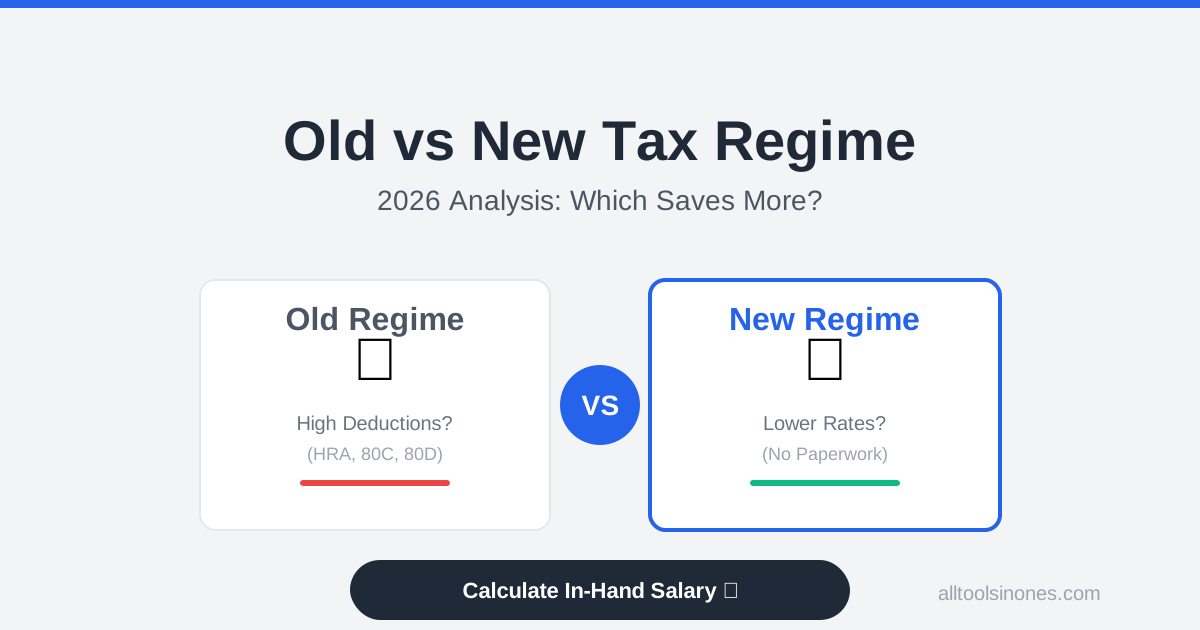
New vs. Old Tax Regime 2026-27: Which Saves More Money for Indian Freelancers?
Stop listening to generic tax advice. Discover why the Old Regime's 'forced investments' might be losing you money in 2026, and how Section 44ADA changes the game for freelancers.
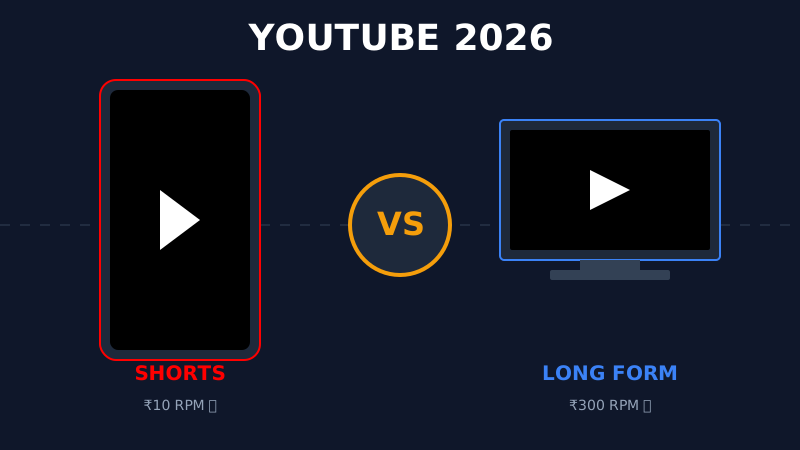
YouTube Shorts vs. Long-form: Which Strategy Pays Better in 2026?
1M Short views = ₹5,000. 50k Long views = ₹30,000. Discover the brutal truth about YouTube RPM in 2026 and why the 'Hybrid Model' is the only sustainable path for Indian creators.

How to Monetize Instagram Reels in India: A 2026 Blueprint for New Creators
I have 10k followers but 0 rupees. Sound familiar? Stop chasing viral vanity metrics. Here is the 2026 blueprint to earning ₹50,000+ with just 5,000 loyal followers in boring niches.