GST Compliance & Invoicing Guides
Learn how to calculate Goods and Services Tax (GST) for different invoicing sums. Understand filing deadlines, registrations, and LUT rules.
Select Your Income Billing Bracket
GST on 50,000 Income
Learn how to calculate GST on a Rs 50,000 income in India. Compare inclusive and exclusive calculations, understand registration rules, and file returns.
GST on 1,00,000 Income
Learn how to calculate GST on a Rs 1,00,000 income in India. Compare inclusive and exclusive calculations, understand registration rules, and file returns.
GST on 2,00,000 Income
Learn how to calculate GST on a Rs 2,00,000 income in India. Compare inclusive and exclusive calculations, understand registration rules, and file returns.
GST on 5,00,000 Income
Learn how to calculate GST on a Rs 5,00,000 income in India. Compare inclusive and exclusive calculations, understand registration rules, and file returns.
GST on 10,00,000 Income
Learn how to calculate GST on a Rs 10,00,000 income in India. Compare inclusive and exclusive calculations, understand registration rules, and file returns.
About GST Invoices
Freelancers and boutique agencies in India must follow strict invoicing guidelines once their annual turnover crosses the Rs 20 Lakhs registration threshold.
Our guide pages outline the GST exclusive (adding 18% on top) and inclusive calculations, return filing deadlines, and input tax credit benefits.
Related Calculator
GST Calculator →Managing the Goods and Services Tax (GST) is essential for freelancers, consultants, and business agencies operating in India. GST has replaced a complex web of service tax and sales levies, creating a unified indirect tax system. This index page collects our detailed guides showing tax calculations and compliance rules for different income levels.
Our guides cover income levels from Rs 50,000 up to Rs 10,00,000, illustrating inclusive vs. exclusive calculations, outlining return filing cycles (GSTR-1, GSTR-3B), and explaining LUT filing for zero-rated service exports. Select your income level below to review the tax guidelines.
Explore GST & Invoicing Guides
GST on 50,000 Income
GST calculation tables, filing obligations, and input tax credit rules for Rs 50,000.
GST on 1,00,000 Income
GST calculation tables, filing obligations, and input tax credit rules for Rs 1,00,000.
GST on 2,00,000 Income
GST calculation tables, filing obligations, and input tax credit rules for Rs 2,00,000.
GST on 5,00,000 Income
GST calculation tables, filing obligations, and input tax credit rules for Rs 5,00,000.
GST on 10,00,000 Income
GST calculation tables, filing obligations, and input tax credit rules for Rs 10,00,000.
GST Registration Thresholds and Exemptions
Service providers in India do not need to register for GST unless their annual gross turnover exceeds Rs 20 Lakhs. For Special Category States in the North-East, this registration threshold is set at Rs 10 Lakhs. If your total annual receipts are under these limits, you are exempt from collecting or remitting GST.
However, you can opt for voluntary registration to claim Input Tax Credit on office expenditures. If you register, you must issue tax-compliant invoices and file monthly or quarterly returns (GSTR-1 and GSTR-3B) even if you had zero transactions during the period.
Zero-Rated Supplies: Exporting Services
If you serve clients located outside India, your services are classified as an export of services and are zero-rated. This means you charge 0% GST, provided the client pays you in convertible foreign exchange and you file a Letter of Undertaking (LUT) on the GST portal annually. The LUT eliminates the need to pay 18% tax upfront and later claim refunds, preserving your working capital.
Filing GSTR-1 and GSTR-3B: A Walkthrough
Taxpayers must understand the monthly or quarterly compliance cycles to avoid late fees. GSTR-1 is filed by the 11th of the following month (for monthly filers) or by the 13th of the month succeeding the quarter (for quarterly filers under the QRMP scheme). It records all outbound invoices, identifying the GSTIN of your business customers so they can claim Input Tax Credit. GSTR-3B is a self-declared summary of outward supplies, input tax credits, and payment of interest or late fees. It must be filed by the 20th to 24th of the following month depending on state-level assignments. Completing these filings correctly ensures business compliance and smooth tax processing.
Detailed Steps for GST Registration and Setup
Registering for GST is a digital process completed on the official GST Common Portal (gst.gov.in). To apply for registration, you need documents like your PAN card, Aadhaar card, proof of business address (such as a utility bill, rent agreement, or consent letter), bank account details, and passport-size photographs. The application is submitted online through Form GST REG-01. Once submitted, a Temporary Reference Number (TRN) is generated, and the tax officer reviews the application. If approved, you receive a GSTIN and a Registration Certificate in Form GST REG-06 within 3 to 7 working days. Once registered, you must display your GSTIN on your business signboard, invoices, and website, and configure your accounting systems to track tax collected and paid.
Input Tax Credit (ITC) Reconciliation Protocols
Reconciling your input tax credits is vital to prevent tax leakage in service businesses. You can claim credit for the GST paid on coworking rents, internet connections, software tool licenses, and subcontractor fees. However, you must match your purchase records with the auto-generated GSTR-2B statement on the GST portal monthly. If a vendor or subcontractor fails to upload their sales invoice on time, the credit will not reflect in your GSTR-2B, and claiming it can attract notices. Establishing automated matching systems keeps your agency compliant.
GST Audit and Assessments for Service Providers
As your service business grows, the tax department may initiate audits or assessments to verify your tax returns. Businesses with an annual turnover exceeding Rs 5 Crores are required to file a self-certified reconciliation statement in Form GSTR-9C along with the annual return in Form GSTR-9. Maintaining clean accounting records, tax invoices, purchase vouchers, and bank statements is essential to verify transactions during assessments. Tax compliance helps in securing corporate client contracts, as large firms prefer dealing with GST-compliant vendors.
Managing E-Invoicing under GST
E-invoicing is a system where business-to-business (B2B) invoices are validated electronically by the GST Network. Currently, e-invoicing is mandatory for businesses with an aggregate annual turnover exceeding Rs 5 Crores in any preceding financial year. Under this system, the invoice data is uploaded to the Invoice Registration Portal (IRP), which generates a unique Invoice Reference Number (IRN) and a QR code. The QR code must be printed on the invoice copy shared with customers. E-invoicing reduces manual errors, ensures real-time reporting, and automates sitemap tasks for tax filings.
Applying for a LUT (Letter of Undertaking)
The Letter of Undertaking (LUT) is a crucial document for Indian service exporters. It is applied for online through the GST portal (Form GST RFD-11) at the start of each fiscal year. The LUT allows you to supply services outside India without paying integrated tax (IGST) upfront. This prevents your business funds from being blocked in tax refund processes, ensuring your freelance or agency business maintains high cash liquidity to cover operating expenses. The approval is usually instant and automated.
GST Compliance for Multi-State Corporate Operations
As service businesses grow, they often open branch offices or employ remote staff across multiple Indian states. Navigating multi-state GST compliance requires registering for a separate GSTIN in each state where your business has a physical location or delivers services. Managing state-specific returns involves tracking Central GST (CGST) and State GST (SGST) splits for intra-state billing, alongside Integrated GST (IGST) for inter-state services, ensuring accurate tax allocation.
Failing to register in states where you maintain business operations can attract severe compliance penalties and block your ability to claim Input Tax Credit on local purchases like coworking rents or office supplies. Establishing centralized accounting software that dynamically handles multi-state billing splits is essential to protect your business margins and pass corporate compliance audits cleanly during annual reconciliations.
The Role of the Invoice Registration Portal (IRP) in E-Invoicing
For large-scale service agencies and corporate entities, the Invoice Registration Portal (IRP) is a central pillar of digital tax compliance. Under the e-invoicing mandate, businesses must upload standard invoice data to the portal electronically. The IRP validates the transaction details, registers the invoice under a unique Invoice Reference Number (IRN), and generates a signed QR code that must be printed on the invoice copy shared with your customer.
This process ensures real-time reporting of B2B transactions, preventing tax evasion and simplifying tax return preparation. Invoices issued without the registered IRN and QR code are considered invalid by corporate clients, as they cannot use them to claim Input Tax Credit. Understanding e-invoicing thresholds is essential for growing service providers to adapt to tax changes smoothly.
Calculate GST Inclusive & Exclusive Split
Need to prepare client invoices or understand your exact tax liability with different tax slabs (5%, 12%, 18%, 28%)? Use our free calculator.
Go to GST CalculatorRelated Articles
Insights and guides to help you make the most of our tools.
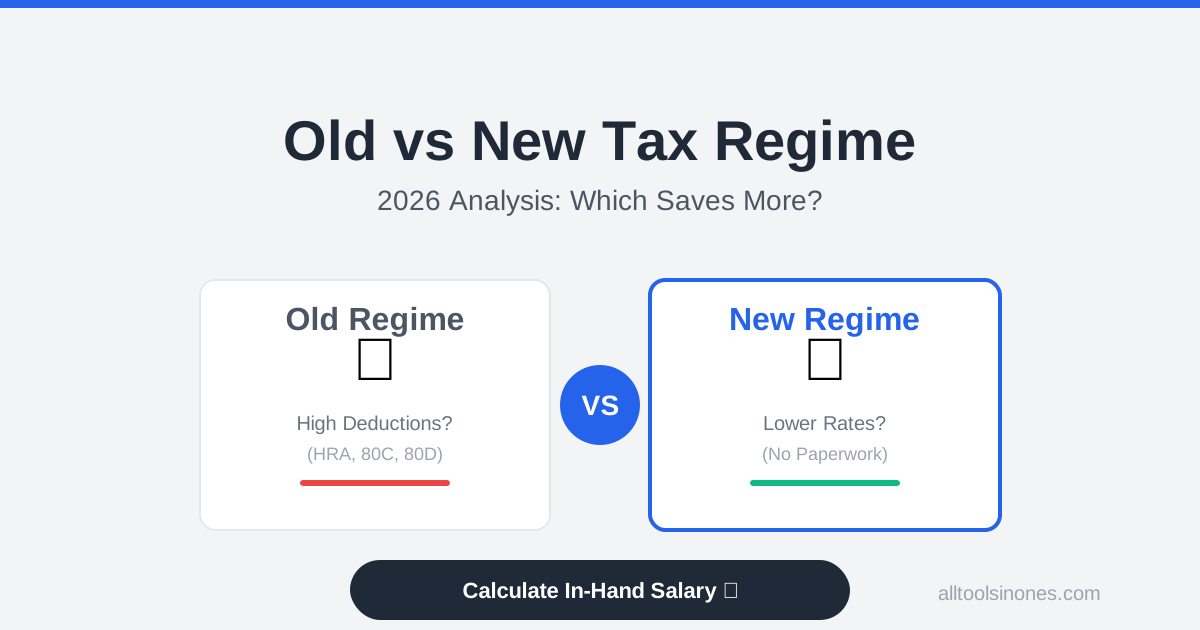
New vs. Old Tax Regime 2026-27: Which Saves More Money for Indian Freelancers?
Stop listening to generic tax advice. Discover why the Old Regime's 'forced investments' might be losing you money in 2026, and how Section 44ADA changes the game for freelancers.
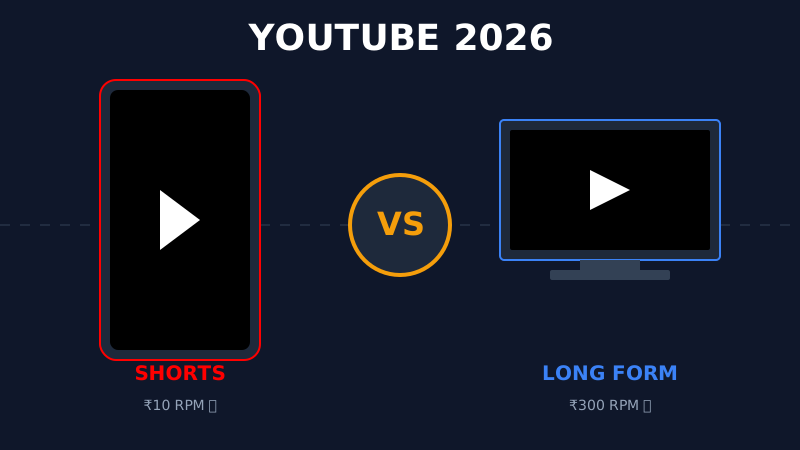
YouTube Shorts vs. Long-form: Which Strategy Pays Better in 2026?
1M Short views = ₹5,000. 50k Long views = ₹30,000. Discover the brutal truth about YouTube RPM in 2026 and why the 'Hybrid Model' is the only sustainable path for Indian creators.
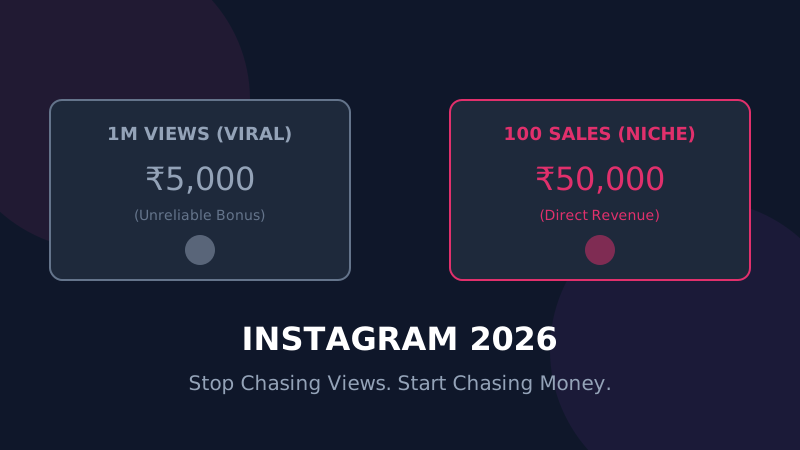
How to Monetize Instagram Reels in India: A 2026 Blueprint for New Creators
I have 10k followers but 0 rupees. Sound familiar? Stop chasing viral vanity metrics. Here is the 2026 blueprint to earning ₹50,000+ with just 5,000 loyal followers in boring niches.